Proudly serving Scottsdale, Mesa, Tempe, Phoenix, Chandler, Gilbert & surrounding areasCall or Text 24/7: 602-905-5399
Aerial view of a paved asphalt parking lot at an office complex in Scottsdale, AZ with desert mountains in the distance.

Asphalt Repair in Scottsdale, AZ for Pothole Patching and Surface Restoration

Scottsdale Asphalt is a licensed and insured asphalt contractor serving residential and commercial properties in Scottsdale, AZ. We provide asphalt repair, asphalt paving, sealcoating, resurfacing, overlay, pothole filling, crack repair, and full-depth replacement for driveways, parking lots, private roads, and commercial surfaces. Scottsdale's heat, UV exposure, and monsoon storms can turn small cracks into larger pavement failures fast. Our goal is to protect safety, curb appeal, and long-term pavement value with repairs matched to the actual condition of your surface.

Every repair starts with pavement condition, not a one-size-fits-all sales pitch. We use durable hot mix asphalt and properly graded base materials sized for Arizona soil conditions, then focus on the compaction, tack coat adhesion, and drainage details that help repairs hold. Our crews understand oxidation, raveling, rutting, reflection cracking, edge failures, and caliche-heavy subsoils common around Scottsdale. You get a clear, itemized estimate before work begins, whether the right answer is a targeted patch, mill and overlay, or full-depth replacement.

Summer temperatures that routinely exceed 110°F, intense UV exposure, and monsoon water intrusion all shorten pavement life in Scottsdale. We inspect the surface, base, drainage, and traffic patterns before recommending crack filling, pothole repair, resurfacing, sealcoating, or replacement.

Scottsdale Asphalt provides asphalt repair for driveways, parking lots, HOA roads, and private pavement throughout Scottsdale, Paradise Valley, Tempe, Mesa, Chandler, Gilbert, Phoenix, and nearby communities.

★ ★ ★ ★ ★5/5 Customer Rating · 26 Years in the Asphalt Trade · Thousands of Paving Jobs Completed · Licensed, Bonded & Insured · Homes, Businesses & Commercial Sites

Asphalt Repair Services & Benefits

What Is Asphalt Repair?

Asphalt repair restores damaged pavement before surface defects spread into the base course. In Scottsdale, that can mean filling cracks, patching potholes, stabilizing failed edges, correcting raveling, or replacing a full-depth section where the base has lost support. The right method depends on whether the distress is cosmetic, surface-level, or structural.

Local conditions matter because asphalt binder hardens through oxidation when heat and UV exposure are constant. Properly installed and maintained asphalt in Phoenix-area climates typically lasts 12 to 18 years, compared with 20 to 30 years in cooler regions. Repair decisions here have to account for thermal movement, monsoon moisture, caliche-heavy subsoils, and sudden high-volume rainfall during July and August monsoon events.

Our repair approach starts with an inspection of cracks, potholes, drainage, base stability, traffic wear, and existing asphalt thickness. When the base is sound, patching, sealcoating, resurfacing, or overlay may be enough. When alligator cracking, saturated subgrade, or soft spots are present, we recommend full-depth repair or replacement instead of covering failure with a short-lived surface layer.

Benefits of Timely Asphalt Repair

Small asphalt problems are less expensive to fix before heat, traffic, and monsoon water push damage deeper. The National Center for Asphalt Technology has reported that $1 spent on timely maintenance can prevent $6 to $10 in future reconstruction costs. Scottsdale property owners benefit most when cracks, potholes, and oxidized surfaces are addressed before the base course fails.

  • Reduces water infiltration before cracks reach the base material.
  • Helps prevent potholes, alligator cracking, and failed driveway edges.
  • Improves curb appeal for homes, HOAs, retail centers, and commercial lots.
  • Supports safer vehicle and pedestrian movement across parking areas.
  • Keeps repair scopes smaller than full tear-out and replacement when caught early.
  • Protects properly compacted base material from traffic flexing and monsoon saturation.
  • Extends pavement service life when paired with sealcoating and crack sealing.
  • Gives owners a clear itemized estimate based on actual pavement condition.
Asphalt Repair Services

Asphalt Repair Services

Scottsdale Asphalt handles targeted asphalt repairs, urgent assessments, long-term pavement maintenance, and larger resurfacing work for residential and commercial properties. Each service is matched to the pavement condition, traffic load, drainage needs, and base stability we find on site.

Emergency Asphalt Assessment

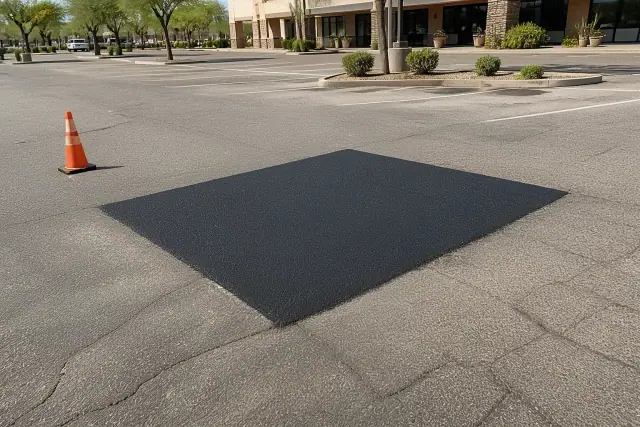
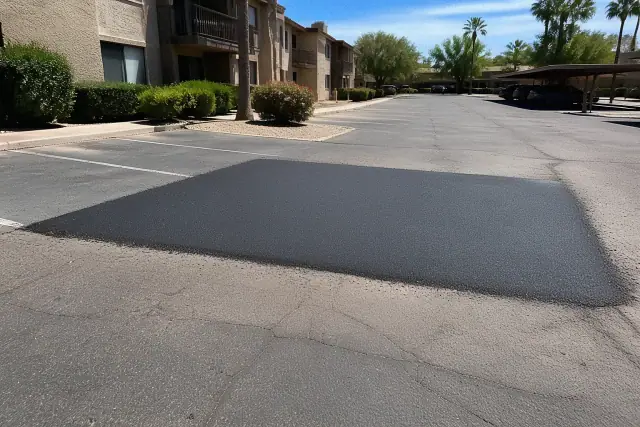
Freshly patched dark asphalt repair in an apartment complex parking lot in Scottsdale, AZ.

When a pothole opens overnight or a driveway edge collapses after a storm, we provide same-day asphalt inspection and assessment for urgent situations across Scottsdale and nearby areas. Our crew evaluates structural integrity, checks whether the base is compromised, and explains whether a temporary cold patch, hot patch, or full-depth repair is the right next step.

Request Estimate

Pothole Repair

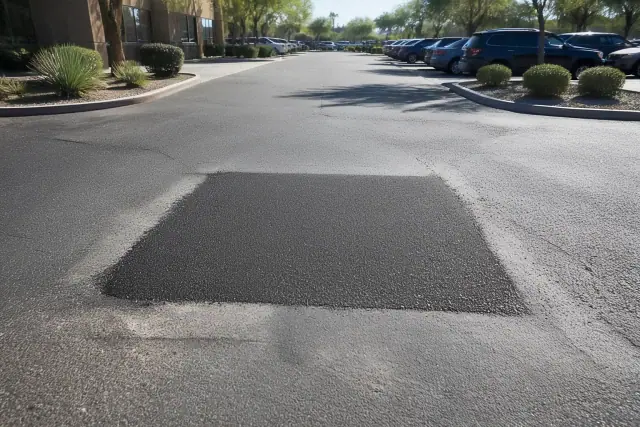
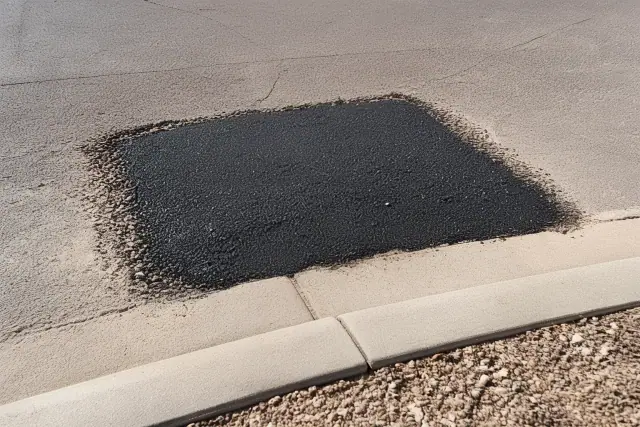
Freshly patched asphalt pothole in an office park parking lot in Scottsdale, AZ.

Pothole repair starts by addressing the failed material under the visible hole. We cut clean edges where needed, excavate to solid base or subbase, compact the repair area, apply tack coat, and install hot mix asphalt in compacted lifts so the patch bonds to sound pavement instead of crumbling at the perimeter.

Request Estimate

Asphalt Crack Repair and Filling

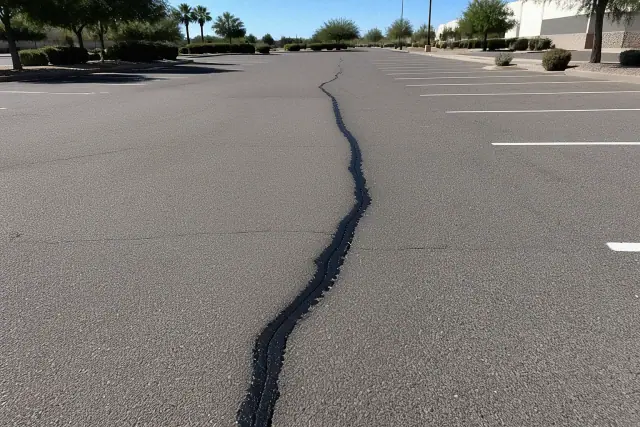
Freshly sealed asphalt crack in a commercial parking lot in Scottsdale, AZ.

Crack repair keeps water from entering the pavement structure during monsoon season. We clean the crack channel with wire brushing or compressed air, choose the appropriate hot-applied rubberized sealant or emulsion-based filler, and seal the opening so thermal movement is less likely to pull the repair apart.

Request Estimate

Asphalt Resurfacing and Overlay

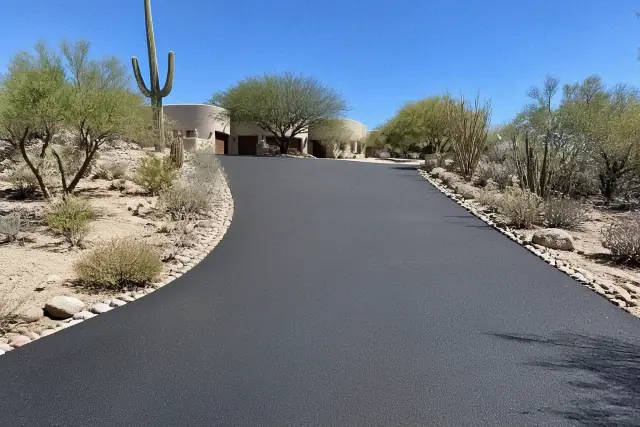
Freshly paved asphalt driveway at a desert property in Scottsdale, AZ.

Resurfacing and overlay are practical when the base is stable and deterioration is limited to the surface. We apply tack coat for adhesion, correct grade and drainage concerns where needed, and place a new hot mix layer that restores appearance and ride quality without unnecessary full replacement.

Request Estimate

Driveway Paving and Repair

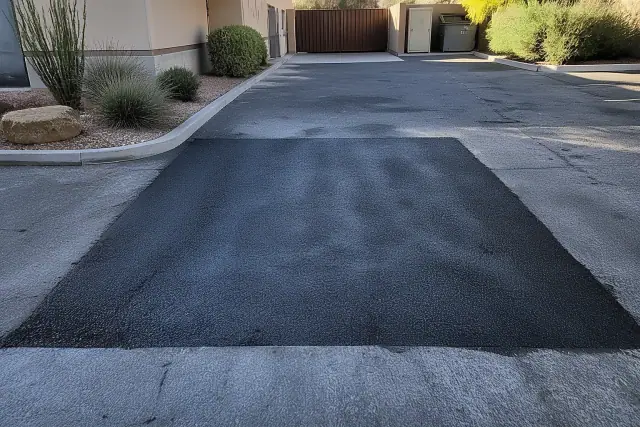
Freshly patched asphalt repair in a restaurant parking lot in Scottsdale, AZ.

Residential driveway repair in Scottsdale has to account for slope, garage aprons, edge support, and drainage. Scottsdale grew from a city of 2,000 at incorporation in 1951 to 241,361 residents at the 2020 census, which means driveway ages vary widely from established neighborhoods like McCormick Ranch and Gainey Ranch to newer north Scottsdale lots. For replacement work, we prepare the subgrade and base carefully, commonly using 4 to 6 inches of compacted Class II base and 3 to 4 inches of finished asphalt depth for residential driveway conditions.

Request Estimate

Commercial Parking Lot Repair

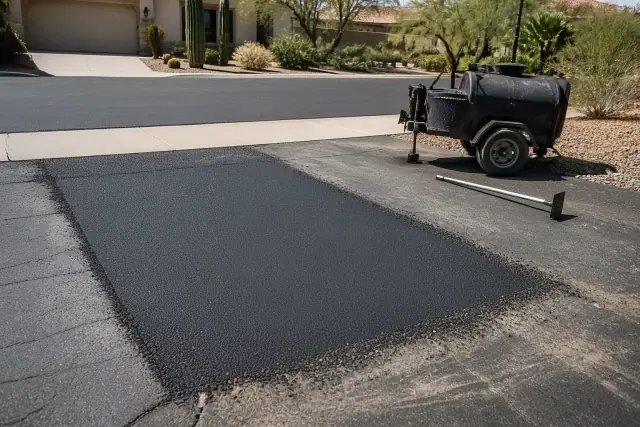
A freshly patched and sealed asphalt driveway in a residential Scottsdale, AZ neighborhood.

Commercial asphalt repair focuses on safety, access, tenant needs, and high-traffic wear. From Old Town retail centers to north Scottsdale corporate campuses, we assess truck routes, loading areas, turning movements, entry and exit lanes, rutting, edge deterioration, and alligator cracking so repair dollars go where the pavement is actually failing.

Request Estimate
Repair Options

Types of Asphalt Repair Solutions

Different asphalt failures call for different repair methods. We separate temporary stabilization, crack sealing, surface patching, full-depth patching, overlay, mill and overlay, sealcoating, and replacement so the scope fits the pavement instead of applying the same fix to every surface.

Freshly paved asphalt patch in a retail center parking lot in Scottsdale, AZ.

Hot Mix Asphalt Patching

Hot mix asphalt patching is used when a durable repair is needed for potholes, failed edges, or cut-out sections. The material must be placed while it is still workable and compacted properly so it bonds with the surrounding pavement.

  • Best for permanent pothole and patch repairs.
  • Installed in compacted lifts for consistent load support.
  • Uses tack coat to bond new asphalt to existing material.
  • Matched to surrounding pavement thickness when practical.
  • Requires controlled curing before normal vehicle traffic resumes.
Request Estimate
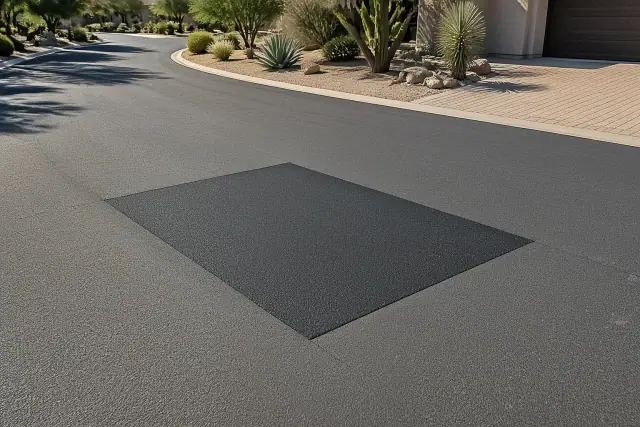
A fresh asphalt patch repair on a neighborhood street edge in Scottsdale, AZ.

Cold Patch and Temporary Stabilization

Cold patch asphalt can restore a safer surface quickly when a permanent repair cannot be completed immediately. We use it as an interim solution for urgent hazards and explain its limits before planning the long-term repair.

  • Useful for short-term stabilization of open holes.
  • Can be opened to traffic faster than hot mix repairs.
  • Appropriate when immediate hazard reduction is the priority.
  • Not intended as a lasting fix for high-traffic failures.
  • Documented so the permanent repair scope is clear.
Request Estimate
Freshly paved asphalt patch on a quiet residential road in Scottsdale, AZ.

Saw-Cut Full-Depth Repair

Full-depth repair is used when the pavement and base beneath the surface are compromised. We saw-cut a clean perimeter, remove failed material, rebuild and compact the base, then place hot mix asphalt so the patch is supported from the bottom up.

  • Recommended for structural base failure and alligator cracking.
  • Creates clean vertical edges that bond better than broken edges.
  • Removes weakened material instead of covering it.
  • Rebuilds load support before new asphalt is placed.
  • Helps stop recurring failures in the same location.
Request Estimate
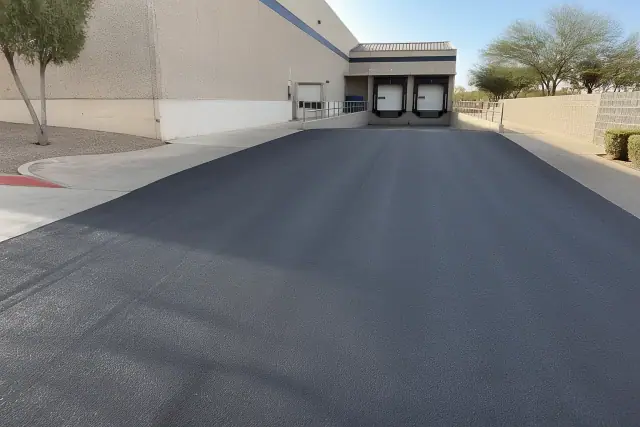
Newly paved asphalt surface at a warehouse loading dock in Scottsdale, AZ.

Mill and Overlay Resurfacing

Mill and overlay removes the worn surface before new asphalt is placed. Milling typically removes 1.5 to 2 inches of oxidized, cracked, or uneven material and restores grade near curbs, drainage channels, garage aprons, and inlets.

  • Works when the base remains structurally sound.
  • Helps correct height conflicts from previous overlays.
  • Uses reclaimed asphalt pavement that can be recycled.
  • Pairs with tack coat for a bonded new surface layer.
  • Often more economical than full tear-out when conditions allow.
Request Estimate
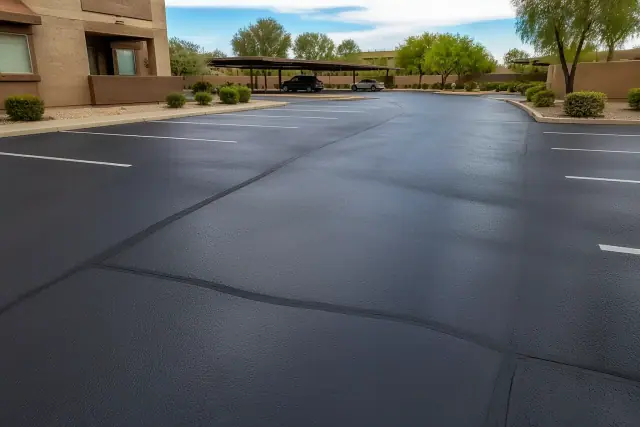
Freshly sealcoated asphalt parking lot with repaired cracks in Scottsdale, AZ.

Sealcoating and Crack Filling Maintenance

Sealcoating and crack filling slow oxidation and help keep water out of the pavement structure. In Scottsdale, sealcoating every two to four years, depending on traffic and exposure, is a cost-effective way to extend pavement life between larger repairs.

  • Hot-applied rubberized sealant is used for many structural cracks wider than 1/8 inch.
  • Emulsion-based fillers help stabilize fine hairline cracks.
  • Sealcoating creates a UV-resistant barrier after repairs have cured.
  • New asphalt should typically cure at least 30 days before sealcoating.
  • A sealed surface makes new cracks easier to spot early.
Request Estimate
Finding Your Right Fit

Choosing the Right Asphalt Repair Solution

Choosing between repair, overlay, and replacement starts with the base condition. Overlay can be a strong option when damage is confined to the top 1.5 to 2 inches and the structure underneath is sound, but it will not hold when alligator cracking covers more than roughly 25% of the surface or soft spots point to base failure. We explain those findings clearly so you understand why we recommend crack filling, patching, resurfacing, mill and overlay, or full-depth replacement.

Local Arizona Pavement Knowledge

Scottsdale pavement fails differently than asphalt in cooler climates. Our repair decisions account for extreme heat, UV oxidation, monsoon moisture, thermal expansion, caliche-heavy subsoils, and the edge failures that appear on commercial driveways and HOA-maintained streets.

Condition-Based Recommendations

We do not push the most expensive option when the pavement can be saved. A targeted patch, crack seal, resurfacing plan, or full replacement recommendation is based on the actual damage pattern, base stability, drainage, and expected traffic load.

Licensed and Insured Work

Scottsdale Asphalt is a licensed and insured asphalt contractor for paving, repair, and sealcoating work in Arizona. We can provide documentation of licensing and insurance before work begins, giving property owners a clearer layer of accountability during the project.

What Sets Us Apart

Why Choose Us for Asphalt Repair?

The difference between a repair that fails quickly and one that lasts often comes down to preparation. We use durable hot mix asphalt, properly graded base materials, tack coat adhesion, compaction, drainage correction, and honest pavement evaluation to address the details that determine whether a repair holds for two years or twenty. Whether the project is a 500-square-foot driveway repair or a 50,000-square-foot commercial parking lot resurfacing, the same foundation-first approach applies.

Request an Inspection

Alligator Cracking

Alligator cracking looks like interconnected scales and usually points to structural base failure. Surface patching alone will not solve it because traffic continues flexing the weakened material below. We inspect the extent of the cracking and recommend full-depth asphalt repair when the base has failed.

Potholes and Failed Edges

Potholes form when water reaches the base, weakens support, and traffic breaks the surface apart. Failed driveway edges are also common where asphalt lacks lateral support. We repair the visible opening and the compromised material underneath so the failure does not keep spreading.

Raveling and Oxidation

Raveling happens when aggregate loosens from the surface as the asphalt binder oxidizes and loses flexibility. In Scottsdale heat, this can accelerate quickly if the surface is left unsealed. Caught early, raveling often responds well to sealcoating and preventive maintenance.

Rutting in Traffic Lanes

Rutting develops where heavy vehicles repeat the same path over soft or improperly compacted base material. Commercial parking lots often show this near truck routes, loading docks, and entry lanes. Repair may require full-depth work in the affected path rather than a thin surface patch.

Reflection Cracking After Overlays

Reflection cracking appears when old cracks telegraph through a new overlay. It is common when a surface is paved over without correcting underlying distress, using proper tack coat, or milling to the right depth. We identify reflection cracking before recommending another overlay.

Monsoon Water Infiltration

During Scottsdale monsoon season, a single inch of rain can arrive in under an hour. Every open crack becomes a path for water to reach the base, loosen aggregate, and soften the subgrade. Crack sealing and drainage attention help stop surface cracks from becoming structural failures.

How it Works

Our Asphalt Repair Process

Our asphalt repair process is built around inspection, correct preparation, proper material placement, and clear communication. We adjust the scope for cracks, potholes, overlays, driveway repairs, and commercial parking lots so the work matches the way the pavement is actually failing.

01.

On-Site Pavement Inspection

We begin by walking the surface and identifying the type, depth, and extent of damage. The inspection looks for cracks, raveling, rutting, potholes, edge failure, drainage issues, soft spots, and signs that water has reached the base.

02.

Repair Scope and Estimate

After the inspection, we explain whether the surface needs crack filling, patch repair, resurfacing, mill and overlay, full-depth replacement, or temporary stabilization. You receive a clear, itemized estimate before work begins so cost is tied to actual pavement condition.

03.

Cutting, Cleaning, and Base Prep

For patch and pothole work, we remove loose material and saw-cut clean edges when needed. We excavate to solid base or subbase, compact the base layer, and clean the repair area so new material can bond correctly.

04.

Tack Coat and Asphalt Placement

We apply tack coat to prepared surfaces and vertical patch walls before placing new asphalt. Hot mix asphalt is installed in lifts and compacted between lifts to create a denser, better-supported repair.

05.

Compaction and Drainage Check

Proper compaction and drainage determine whether the repair can handle Scottsdale heat, traffic, and sudden stormwater. Fresh hot mix must be compacted while still above workable temperature, typically above 185°F for standard mixes.

06.

Cleanup and Cure Guidance

Before we leave, we remove debris, review the finished repair, and explain curing restrictions. Light foot traffic is typically safe after 24 to 48 hours, while vehicle traffic should usually stay off new asphalt for at least 48 to 72 hours.

Get Better Pavement

Schedule an Asphalt
Repair
Inspection

A small crack, pothole, or failed edge can become a larger base problem quickly in Scottsdale weather. Schedule an asphalt inspection with Scottsdale Asphalt to get a clear recommendation, an itemized estimate, and a repair plan for your driveway, parking lot, private road, or commercial surface.

Asphalt Repair Help

Asphalt Repair FAQs

These answers cover common questions about asphalt repair costs, timelines, maintenance, replacement decisions, and local pavement conditions in Scottsdale.

Call Our Asphalt Team

Asphalt repair in Scottsdale typically costs between $2 and $5 per square foot for standard pothole filling and surface patch repairs. Average residential driveway repairs often run roughly $401 to $440, while larger or more damaged surfaces can range from $900 to over $3,100 depending on scope. Full-depth replacement or mill and overlay on large surfaces is usually closer to $3 to $7 per square foot, depending on base conditions, access, and repair type.

Properly installed and maintained asphalt in the Phoenix and Scottsdale area typically lasts 12 to 18 years. That is shorter than the 20 to 30 years often seen in cooler regions because intense UV radiation and heat accelerate binder oxidation. Neglected pavement with unsealed cracks can fail structurally in 8 to 12 years.

Repair is usually appropriate when cracks are isolated, the base course is solid, and damage has not spread structurally. Overlay or resurfacing can work when the existing structure is sound and damage is mostly in the top 1.5 to 2 inches. Replacement is the better choice when the base has failed, soft spots are present, or alligator cracking covers more than roughly 25% of the surface.

The process starts with an on-site inspection to identify damage type, depth, and extent. Crack work includes cleaning, drying, and applying the correct sealant or filler. Pothole and patch repairs can include saw-cutting, excavation to solid base, compaction, tack coat, and hot mix asphalt placed in compacted lifts.

Scottsdale asphalt faces intense UV radiation, extreme thermal movement, and monsoon-driven water infiltration. Summer heat above 110°F accelerates oxidation, while winter nights below 40°F can contribute to thermal contraction. When rainwater enters cracks, it can loosen base aggregate, soften the subgrade, and trigger potholes or alligator cracking.

For many hot patch repairs and pothole fills, light foot traffic is typically safe after 24 hours. Vehicle traffic should usually stay off new asphalt for at least 48 to 72 hours, depending on heat and site conditions. Heavy vehicles such as trucks, RVs, or equipment should stay off new asphalt for a minimum of five to seven days.

Sealcoating is strongly recommended in Scottsdale once new repair material has cured. New asphalt should typically cure at least 30 days before sealcoating, then the surface can be sealed with a coal tar or asphalt emulsion sealer. Many Scottsdale properties benefit from sealcoating every two to four years, depending on exposure and traffic.

Yes. Scottsdale Asphalt is a licensed and insured asphalt contractor for asphalt paving, repair, and sealcoating work in Arizona. Arizona paving and surfacing contractors are licensed through the Arizona Registrar of Contractors under the C-13 specialty contractor classification, and Scottsdale Asphalt carries liability insurance and workers' compensation coverage.

Cold patch can be useful as a temporary repair when a surface needs to be made safer quickly. Hot mix asphalt is the preferred permanent repair material when proper preparation, compaction, and curing time are available. We are direct about cold patch limitations because it will not hold indefinitely in high-traffic Scottsdale conditions.

An overlay can help when the base is sound and cracks are minor or surface-level. It will not fix structural cracking, saturated base material, or widespread alligator cracking. For a longer-lasting overlay, the existing surface must be prepared correctly and bonded with tack coat, and milling may be needed to restore grade.

Water enters through cracks, reaches expansive clay layers or weakened material beneath the pavement, and reduces the base's load-bearing capacity. Traffic then pushes through the weak zone until the asphalt fractures and a pothole forms. On public roads, the City of Scottsdale's pavement program creates repair work orders through Scottsdale EZ within 48 hours of a request, but private driveways and parking lots remain the property owner's responsibility.

Commercial lots in Scottsdale often benefit from a planned asphalt preservation schedule. A typical program may include crack sealing at years two to three, sealcoating at years three to five, spot patching as needed, and resurfacing or mill and overlay at years eight to twelve, depending on traffic. Following that type of schedule can help keep a lot serviceable for 15 to 20 years.

Scottsdale Asphalt provides asphalt repair in Scottsdale and supports residential and commercial customers throughout Paradise Valley, Tempe, Mesa, Chandler, Gilbert, and the broader Phoenix metropolitan area. We work on driveways, parking lots, private roads, commercial surfaces, and HOA-maintained streets where pavement condition affects safety and long-term cost.