Proudly serving Scottsdale, Mesa, Tempe, Phoenix, Chandler, Gilbert & surrounding areasCall or Text 24/7: 602-905-5399
Aerial view of a paved asphalt parking lot at an office complex in Scottsdale, AZ with desert mountains in the distance.

Commercial Parking Lot Paving and Asphalt Construction in Scottsdale, AZ

Scottsdale Asphalt provides parking lot paving in Scottsdale, AZ for commercial properties that need durable asphalt built for desert heat, monsoon drainage, and heavy daily traffic. Our crews handle new construction, full-depth replacement, overlay resurfacing, pothole repair, crack sealing, sealcoating, and line striping. We work on retail centers, restaurants, medical offices, mixed-use properties, loading areas, and commercial lots across Scottsdale and the greater Phoenix metro. Every project starts with the pavement condition, traffic needs, base strength, and drainage pattern instead of a one-size-fits-all paving plan.

Scottsdale's summer pavement temperatures regularly exceed 110°F, and UV exposure can harden asphalt binder until the surface starts cracking, raveling, or fading. Caliche-heavy soils in eastern Maricopa County can also move with moisture changes, so weak base preparation shows up quickly as soft spots, rutting, and potholes. We focus on asphalt mix selection, full subgrade compaction, and slope design because those details separate pavement planned for a 20-year service life from pavement that starts failing in three years. Clear pricing, defined scope, and business-friendly scheduling help property managers know what to expect before work begins.

For Scottsdale parking lots, we evaluate whether the right scope is new paving, a 1.5-inch to 2-inch overlay, targeted full-depth repair, crack sealing, or a maintenance plan. Our recommendations consider ADA striping, customer access, delivery traffic, waste collection areas, and drainage to catch basins or perimeter drains.

Scottsdale Asphalt provides parking lot paving for commercial properties throughout Scottsdale, Paradise Valley, Tempe, Mesa, Chandler, Gilbert, Phoenix, and the broader Phoenix metro area.

★ ★ ★ ★ ★5/5 Customer Rating · 26 Years in the Asphalt Trade · Thousands of Paving Jobs Completed · Licensed, Bonded & Insured · Homes, Businesses & Commercial Sites

Commercial Asphalt Services & Benefits

What Is Parking Lot Paving?

Parking lot paving is the process of preparing the subgrade, building a stable aggregate base, placing hot-mix asphalt, compacting it to specification, and finishing the surface with drainage, striping, and access details. In Scottsdale, that work has to account for high heat, intense UV exposure, monsoon runoff, and caliche-heavy soils beneath much of eastern Maricopa County.

A typical commercial asphalt section may include a 4-inch compacted asphalt surface over a properly prepared aggregate base, with heavier sections at loading docks, waste collection points, fire lanes, and entrance approaches. New construction often starts with 6 to 8 inches of excavation, imported Class II base rock or recycled aggregate base, and compaction to at least 95% Proctor density before asphalt is placed.

Scottsdale's elevation ranges from roughly 1,100 to 4,000 feet, and commercial growth has expanded from a city of about 2,000 residents at incorporation in 1951 to over 241,000 residents in the 2020 census. That growth across Old Town, the Scottsdale Airpark, and the Loop 101 corridor makes a safe, clean, well-marked parking lot an important part of how customers judge a property before they enter the building.

Benefits of Professional Parking Lot Paving

Professional parking lot paving gives commercial properties a stronger surface, better water management, clearer traffic flow, and a more polished first impression. The value comes from matching the pavement design to Scottsdale's climate, the property's traffic, and the condition of the existing base.

  • More durable asphalt mix choices for high-temperature stability and heavy turning movements.
  • Proper grading and compaction that reduce soft spots, rutting, and early pothole formation.
  • Drainage slopes that move monsoon runoff toward catch basins, perimeter drains, or storm infrastructure.
  • Cleaner curb appeal for retail, restaurant, medical office, and mixed-use properties.
  • Phased work options that help active businesses keep tenants, employees, and customers moving.
  • ADA-aware layout for accessible spaces, access aisles, and pavement markings.
  • Repair and overlay options that can extend pavement life when the existing base is still sound.
  • Maintenance planning with crack sealing, sealcoating, patching, and striping intervals matched to local wear.
Parking Lot Services

Parking Lot Paving Services

Scottsdale Asphalt provides the core services commercial properties need throughout a pavement life cycle, from new asphalt installation to resurfacing, repairs, maintenance, and final striping. Each service is scoped after a site assessment so the work addresses the actual cause of pavement distress instead of covering it temporarily.

New Parking Lot Construction

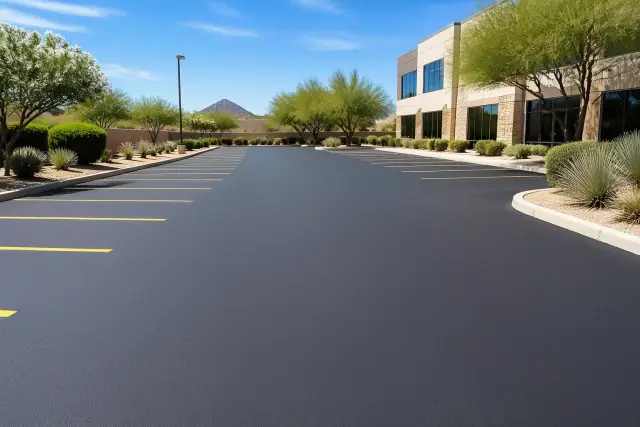
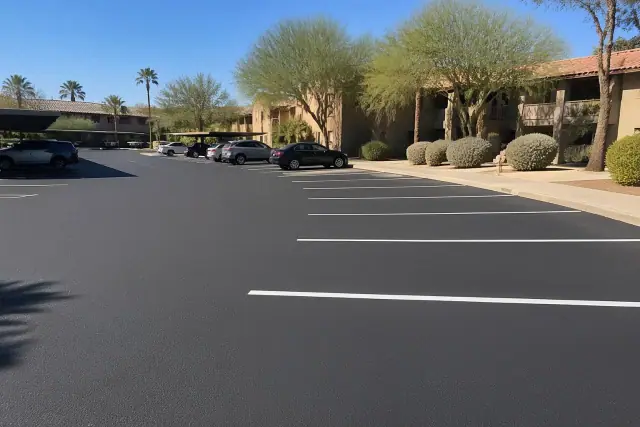
Newly paved asphalt parking lot with white lines and desert landscaping in Scottsdale, AZ.

For new parking lot construction in Scottsdale, we review civil drawings, confirm grades with a laser level, prepare the subgrade, place aggregate base, and install hot-mix asphalt in 1.5-inch to 2-inch compacted lifts. The goal is a pavement section that supports daily customer traffic, delivery vehicles, fire access, and Arizona heat without sacrificing drainage or appearance.

Request Estimate

Full-Depth Replacement

Newly paved asphalt driveway at a residential home in Scottsdale, AZ.

Full-depth replacement is used when the asphalt and base have failed or when potholes, alligator cracking, or sinking show structural distress. We saw-cut defined limits, remove failed material, proof-roll the subgrade with a loaded tandem-axle truck, correct soft zones, recompact the base, and install new asphalt in lifts.

Request Estimate

Asphalt Overlay & Resurfacing

Freshly paved office drive aisle with new yellow parking stripes in Scottsdale, AZ.

Overlay resurfacing is a cost-effective option when the existing base is still structurally sound. We can mill the top 1.5 to 2 inches of asphalt, prepare the surface, apply tack coat, and place a new compacted lift that restores appearance, smoothness, and water-shedding performance without full-depth reconstruction.

Request Estimate

Parking Lot Repair & Patching

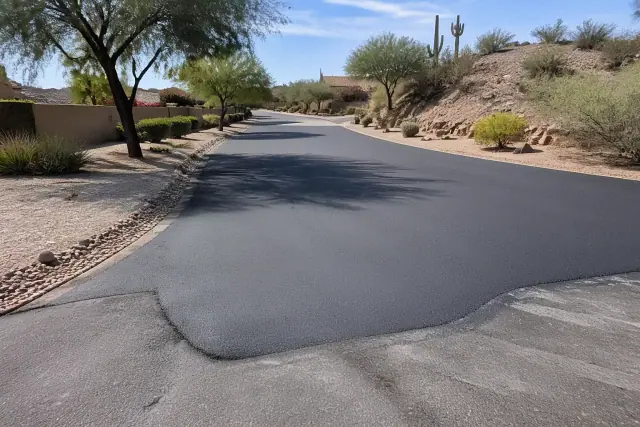
Freshly paved asphalt repair on a residential street in Scottsdale, AZ.

Parking lot repair covers potholes, localized failures, minor rutting, and damaged sections that need targeted work before they spread. Full-depth saw-cut-and-patch repairs remove damaged material to solid subgrade, rebuild the base, and install hot-mix asphalt so the repair is not just a temporary surface fill.

Request Estimate

Crack Sealing & Maintenance

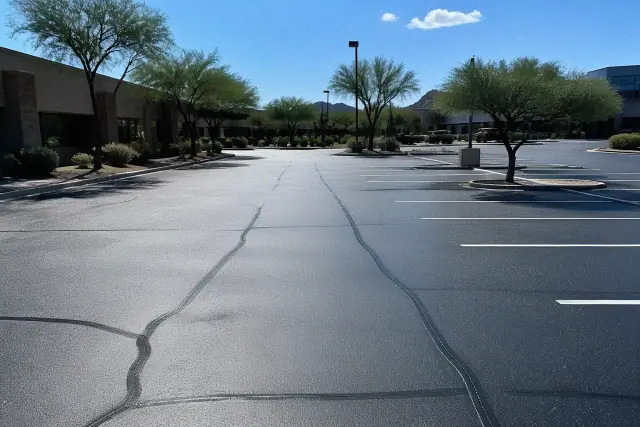
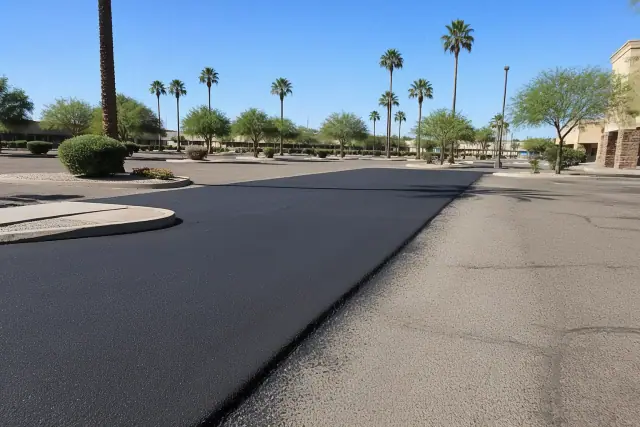
Newly sealed dark asphalt parking lot with fresh black crack filler in Scottsdale, AZ.

Crack sealing keeps water from penetrating into the base during monsoon events and weakening the pavement from below. We route eligible cracks to a uniform profile, clean them, and apply hot-pour rubberized sealant, with many Scottsdale lots benefiting from crack sealing every two to three years as part of a maintenance plan.

Request Estimate

Sealcoating & Line Striping

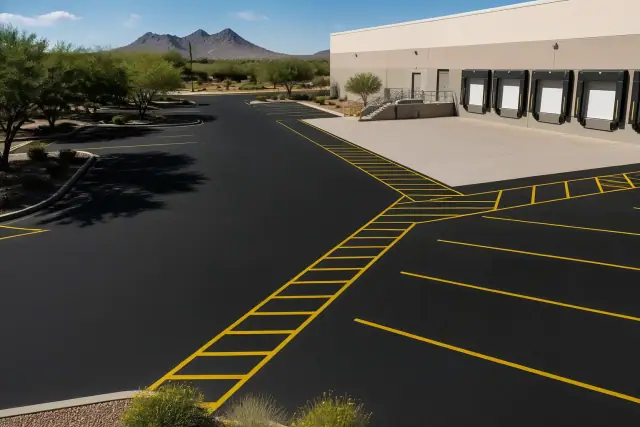
Freshly paved warehouse loading drive with yellow striping on black asphalt in Scottsdale, AZ.

Sealcoating slows UV oxidation, helps resist fuel and oil exposure, and keeps asphalt looking darker and cleaner for arriving customers. Line striping restores stalls, arrows, crosswalks, fire lanes, accessible spaces, and access aisles, with traffic paint or thermoplastic selected based on traffic volume and longevity needs.

Request Estimate
Asphalt Paving Options

Types of Parking Lot Paving Options

The right paving approach depends on whether the property needs a new lot, full-depth reconstruction, resurfacing, heavy-load reinforcement, or a structured maintenance plan. Scottsdale Asphalt evaluates existing pavement, base conditions, drainage, traffic patterns, and operational constraints before recommending an approach.

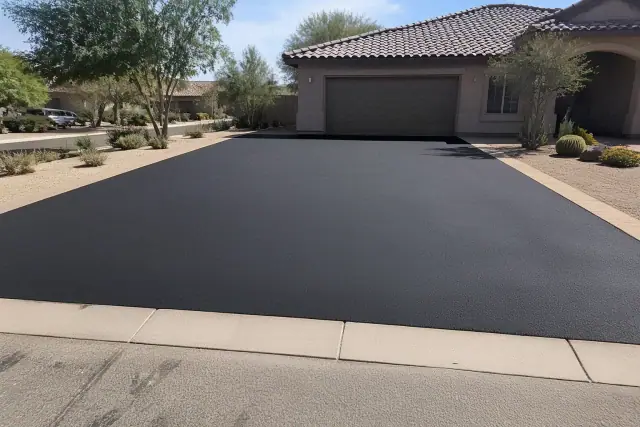
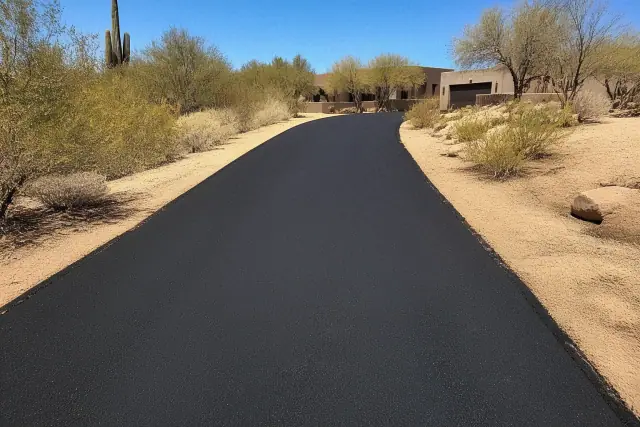
A freshly paved black asphalt driveway at a desert property in Scottsdale, AZ.

New Construction Asphalt Lots

New construction creates the pavement section from the ground up, making it the best time to correct grades, drainage, base thickness, and traffic layout. For many commercial parking lots, the design includes a prepared aggregate base and a 4-inch compacted asphalt surface, with thickness adjusted where heavier loads are expected.

  • Best for undeveloped sites, expansions, and properties replacing dirt or gravel parking.
  • Subgrade is shaped and compacted before Class II base rock or recycled aggregate base is placed.
  • Drainage is designed before asphalt installation so runoff does not sit on the finished surface.
  • Heavy-use areas can receive added thickness near loading docks, waste collection points, and fire lanes.
  • Final striping can be laid out for customer flow, accessible parking, and service vehicle movement.
Request Estimate
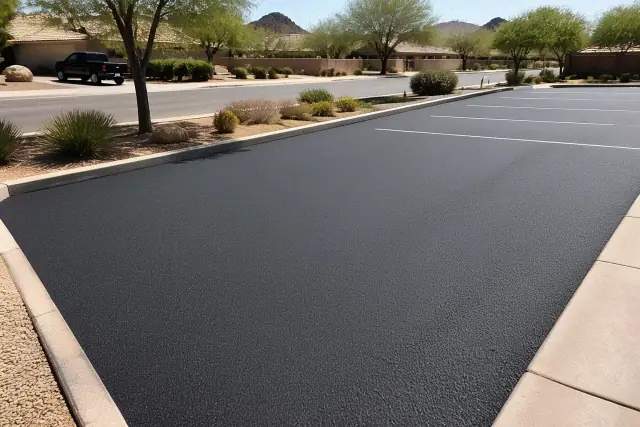
Freshly paved asphalt parking lot on a sunny neighborhood street in Scottsdale, AZ.

Full-Depth Removal & Replacement

Full-depth replacement is the right system when surface distress is tied to base failure rather than shallow wear. Removing the old asphalt lets the crew repair soft subgrade, rebuild the base, and place new hot-mix asphalt instead of trapping failure underneath a fresh surface.

  • Recommended for alligator cracking, widespread potholes, settling, or base saturation.
  • Saw-cut edges create clean repair limits and a professional tie-in to surrounding pavement.
  • Removed asphalt can be coordinated for recycling through Phoenix metro facilities.
  • Base repairs address the reason the pavement failed before new material is installed.
  • Compacted lifts help the finished section meet the required density and grade.
Request Estimate
Freshly paved asphalt parking lot at a restaurant in Scottsdale, AZ.

Milled Asphalt Overlay

A milled overlay balances cost control with a smoother, better-bonded resurfacing result. Milling removes the worn top layer, creates a profiled bonding surface, and allows minor grade corrections before a new overlay is placed.

  • Appropriate when cracking and oxidation are mostly surface-level and the base remains sound.
  • Common overlay thicknesses are 1.5 inches to 2 inches after surface preparation.
  • Milling helps maintain curb reveal, transitions, drain inlets, and driveway approaches.
  • Tack coat is applied so the new asphalt bonds to the existing pavement.
  • Failed sections should be patched full depth before the overlay goes down.
Request Estimate
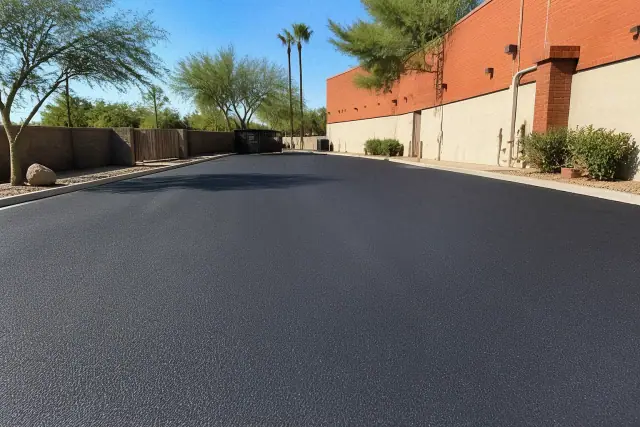
Freshly paved asphalt parking lot with clean transitions and distant palm trees in Scottsdale, AZ.

Heavy-Load Asphalt Sections

Some parts of a commercial lot carry more stress than ordinary parking stalls. Entrance drives, turning lanes, refuse areas, delivery paths, and fire lane approaches may need stronger mix choices, additional thickness, and closer compaction control.

  • Polymer-modified binders can resist rutting in high-temperature commercial applications.
  • Mix selection helps avoid the softening problems associated with standard unmodified AC-20 in sustained heat.
  • Waste collection and loading zones are evaluated separately from standard parking areas.
  • Compaction is managed while hot-mix asphalt remains in its workable temperature range.
  • Stronger sections reduce shoving, tracking, and surface distortion under repeated loads.
Request Estimate
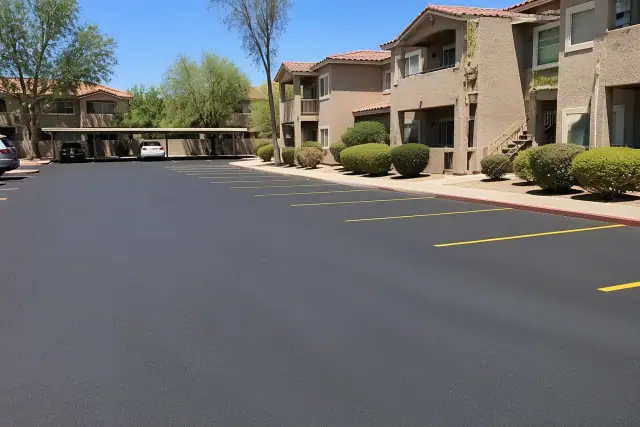
Freshly paved asphalt parking lot with bright yellow lines at an apartment complex in Scottsdale, AZ.

Maintenance-Based Pavement Plans

A maintenance-based system uses smaller interventions on a predictable schedule to slow deterioration and delay major resurfacing. It combines crack sealing, sealcoating, patching, and restriping based on the surface condition and the property's traffic.

  • Cracks wider than 1/4 inch are candidates for routing and sealing before water reaches the base.
  • Sealcoating every three to five years can slow UV oxidation in Scottsdale's high-sun environment.
  • Spring and fall are often ideal because sealcoating and crack sealing cure best around 50°F to 90°F.
  • Prompt pothole repair keeps localized failures from becoming larger structural repairs.
  • Fresh markings improve stall organization, pedestrian paths, and driver expectations.
Request Estimate
Finding Your Right Fit

Choosing the Right Parking Lot Approach

Choosing between new paving, full-depth replacement, overlay resurfacing, patching, or maintenance starts with the condition of the base. An overlay can fail within two to three years if it is placed over structural cracking or soft subgrade, so Scottsdale Asphalt separates surface wear from base failure before recommending a scope.

Scottsdale Climate Expertise

Our paving recommendations are built around Scottsdale's heat, UV exposure, monsoon runoff, and caliche-heavy soils. We account for high pavement temperatures, eastern Maricopa County soil behavior, and commercial traffic so the finished lot is designed for the environment it will actually face.

Base & Drainage First

We do not treat asphalt as a surface-only project. Grading, proof-rolling, base repair, compaction, and drainage paths are addressed before paving because water infiltration and weak base support are two of the fastest ways a Scottsdale lot fails early.

Clear Scope, Less Disruption

Property managers need to know what is included, when the work starts, and how customers, tenants, and employees will move through the site. We define the scope, communicate the schedule, and phase work when needed so businesses can keep operating during paving.

What Sets Us Apart

Why Choose Us for Parking Lot Paving?

Scottsdale Asphalt combines local paving knowledge with practical project planning for commercial lots throughout Scottsdale and the Phoenix metro. From mix selection and base verification to ADA-aware striping and final cleanup, the process is designed to produce a durable lot without leaving property owners guessing about scope, access, or next steps.

Request Lot Assessment

Heat Rutting & Surface Distortion

Sustained summer heat can soften unsuitable asphalt binders, especially in turning lanes, entrance approaches, and heavy-traffic zones. Rutting, tracking, shoving, and surface distortion are signs the pavement needs the right mix, section thickness, and compaction approach for Scottsdale conditions.

Oxidation, Raveling & Fading

Arizona UV exposure hardens asphalt binder over time, which weakens the aggregate bond and leads to fading, raveling, and brittle surface cracking. Sealcoating on a regular schedule helps slow that process and keeps commercial lots looking cared for.

Poor Drainage & Standing Water

Scottsdale monsoon storms can overwhelm weak drainage quickly. A minimum 2% cross-slope helps move water toward catch basins and perimeter drains before it sits on the surface or infiltrates the base.

Potholes & Base Failure

Potholes often start as water infiltration, soft subgrade, or failed base rather than a simple hole in the surface. Full-depth patching removes damaged material, repairs the base, and places new asphalt in compacted lifts so the same problem is less likely to return.

Faded Striping & ADA Concerns

Faded stalls, missing arrows, and unclear accessible spaces create confusion and liability exposure. We lay out striping with attention to accessible parking spaces, access aisles, signage locations, driving aisles, and current ADA Standards for Accessible Design.

Open Cracks & Water Intrusion

Unsealed cracks let monsoon water reach the base, where it can soften support and turn a surface crack into structural damage. Routing cracks to about 3/4-inch wide by 3/4-inch deep helps sealant achieve proper depth and adhesion before the crack grows.

How It Works

Our Parking Lot Paving Process

Our process is designed to identify why the pavement is failing, choose the right scope, and complete the work with minimal avoidable disruption. Each step builds toward a durable surface, better drainage, safer traffic flow, and a clean finish for commercial properties in Scottsdale.

01.

Site Assessment & Scope Planning

We walk the property, review traffic flow, utility locations, drainage patterns, ADA needs, and existing pavement condition before pricing the work. For new construction, we review plans and confirm grades; for existing lots, we determine whether repair, overlay, or full-depth replacement is the right approach.

02.

Demolition, Milling & Surface Removal

When existing pavement must come out, we saw-cut clean limits and remove or mill asphalt based on the project scope. Reclaimed asphalt is coordinated for recycling where possible, and the exposed surface is prepared for base verification and repair.

03.

Subgrade Proof-Rolling & Base Repair

After removal, we proof-roll the subgrade with a loaded tandem-axle truck to identify soft zones. Failing areas are excavated, treated or replaced with engineered fill, and recompacted so the base can support the new asphalt section.

04.

Drainage Grading & Slope Setup

We shape the lot so water moves off the driving surface instead of sitting in low spots or entering the base. Drainage planning considers the property's topography, catch basins, perimeter drains, and available storm infrastructure.

05.

Hot-Mix Asphalt Placement & Compaction

Hot-mix asphalt typically arrives between 275°F and 325°F and must be placed and compacted before it cools below workable range. We use steel drum vibratory rollers to target the specified density, commonly 92% to 96% of maximum theoretical density depending on mix and lift thickness.

06.

Finishing, Striping & Cleanup

The finished surface is checked for grade, slope, and density before striping begins. Pavement markings are applied with traffic paint or thermoplastic, debris is removed, and the site is left organized for tenants, employees, and customers.

Get Better Pavement

Schedule a Parking
Lot Paving
Consultation

Ready to plan a safer, cleaner, longer-lasting commercial parking lot in Scottsdale? Request an estimate and Scottsdale Asphalt will review the site's paving, drainage, repair, maintenance, and striping needs with a clear scope before work begins.

Parking Lot Help

Parking Lot Paving FAQs

Have questions about parking lot paving, resurfacing, maintenance, or repair in Scottsdale? These answers cover common cost, timeline, material, drainage, permit, and maintenance questions for commercial asphalt lots.

Call Our Paving Team

Both can work in Scottsdale, but they serve different budgets and ownership plans. Concrete may last 30 to 40 years before major replacement, while well-maintained asphalt often reaches 20 to 25 years. Asphalt usually has a lower upfront cost, faster installation, and easier sectional repair, but it needs sealcoating and crack sealing to reach its full service life in Arizona heat.

With routine sealcoating, crack sealing, and patching, many commercial lots need resurfacing or full repaving roughly every 15 to 25 years. High-traffic, heavy-load, poorly drained, or neglected lots may need work sooner, and unmaintained Scottsdale asphalt can show oxidation, raveling, and structural cracking within 10 to 12 years.

The timeline depends on size, scope, base work, and whether the lot must stay partially open. A straightforward 10,000- to 20,000-square-foot commercial lot often takes two to four days from mobilization through striping, while larger or heavily damaged lots can take a week or more. Hot-mix asphalt can often accept foot traffic within a few hours and vehicle traffic within 24 to 48 hours depending on surface temperature and mix design.

Pricing depends on lot size, existing condition, thickness, drainage, striping, and whether the work is overlay or full-depth replacement. In the Phoenix metro market, a 2-inch overlay runs approximately $1.39 to $1.57 per square foot for materials. A representative 10,000-square-foot full-depth project with striping can run in the range of $18,000 to $25,000 or more depending on site-specific conditions.

The most common causes are weak base preparation, poor drainage, and deferred maintenance. Scottsdale heat and UV exposure accelerate binder oxidation, while monsoon water can reach the base through open cracks and low spots. When the base softens or was never compacted properly, surface issues can turn into rutting, potholes, and structural cracking.

Routine maintenance such as crack sealing, sealcoating, and restriping often does not require permits. New parking lot construction and significant reconstruction generally may require grading and paving permits through the City of Scottsdale Development Services Department, and drainage changes may involve Maricopa County flood control review. ADA compliance should also be reviewed when accessible parking areas are affected.

Yes, asphalt paving can continue through Arizona summers, but the schedule and crew plan need to account for heat. Warm weather helps hot-mix asphalt stay workable longer during transport and placement, but crews still need safe timing, hydration, and temperature monitoring. What matters most to the finished lot is meeting compaction requirements while the mix is still in range.

Resurfacing adds a new asphalt layer over a prepared existing pavement, often after milling the top surface. Full-depth replacement removes failed asphalt and rebuilds the base before new asphalt is installed. If the base is stable, overlay can be cost-effective; if the base is failing, an overlay can fail prematurely within two to three years.

Cracks wider than 1/4 inch should be evaluated for routing and sealing before water gets into the base. Waiting until cracks reach 1 inch or more reduces sealant effectiveness and can allow deeper saturation. For many Scottsdale lots, crack sealing every two to three years is a practical maintenance interval.

Many commercial parking lots benefit from sealcoating every three to five years, depending on traffic, sun exposure, fuel spills, and surface condition. The best curing windows are often spring and fall, when temperatures are commonly closer to the 50°F to 90°F range preferred for crack sealing and sealcoating materials.

Parking lot striping can include stalls, arrows, fire lanes, pedestrian paths, crosswalks, accessible parking spaces, access aisles, and signage layout. Traffic paint is common for many lots, while thermoplastic can last three to seven years under heavier traffic conditions. Clear markings improve traffic flow and reduce conflict points for drivers and pedestrians.

Drainage is addressed through grading, cross-slope, inlet transitions, and repair of low spots before the asphalt is placed. On many paved surfaces, a minimum 2% cross-slope helps move monsoon runoff to catch basins or perimeter drains instead of letting water sit on the lot. If existing drainage is inadequate, catch basin or storm infrastructure work may be recommended before paving.

Scottsdale Asphalt provides parking lot paving in Scottsdale and supports nearby communities including Tempe, Mesa, Chandler, Gilbert, Paradise Valley, Phoenix, and the greater Phoenix metropolitan area. Service is focused on commercial properties such as retail centers, restaurants, medical offices, mixed-use properties, and high-traffic parking installations.